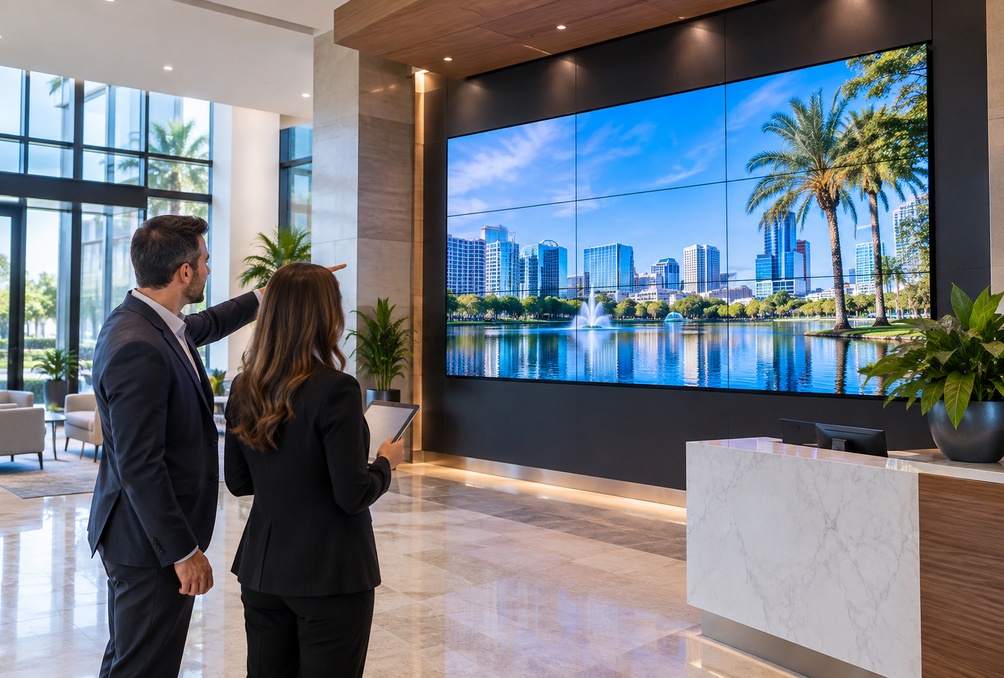
A lobby video wall is a significant investment, and the spec sheet alone will not tell you whether a display is right for your space. Getting the resolution, panel type, and content system matched to your actual viewing environment requires a site assessment before any purchasing decision is made. Call Axiom Integration at (407) 775-2222 or schedule a site visit to get a recommendation built around your lobby, not a catalog.
Central Florida facility managers evaluating video walls for lobbies, reception areas, and common spaces run into the same problem: the terminology is dense, the product options are numerous, and the wrong choice shows up as a visible grid across your branding content or a display that looks sharp in a showroom but washed out in a sun-facing lobby. The decisions that matter most are not complicated once they are explained in the context of how your space actually works. Here is what drives each one.
How Do You Match Resolution and Pixel Pitch to Your Viewing Distance?
Pixel pitch is the measurement that most facility managers have not heard of before they start evaluating video walls, and it is the one that matters most for image quality at a given distance. Pixel pitch describes the distance in millimeters between the center of one LED cluster and the center of the next. A smaller number means pixels are closer together, which produces a sharper image at close range. A larger number means pixels are spaced further apart, which is acceptable when viewers are standing further back but looks coarse up close.
For a lobby where visitors are standing at a reception desk or passing through an entry at conversational distance, a pixel pitch in the 1.2 to 2.0 millimeter range typically produces a clean, sharp image. For a larger atrium or a display intended to be read from across a wide open space, a pitch of 2.5 to 4.0 millimeters delivers a good result at a fraction of the cost. Specifying a fine-pitch display for a large-distance application spends budget on resolution the viewer will never perceive. Specifying a coarse display for a close-range lobby creates a visible dot pattern across your logo and messaging that no amount of content quality will fix.
Resolution follows from pixel pitch and overall display size. A 2x3 panel configuration at a given pitch produces a specific total resolution, and that resolution needs to match the aspect ratio and output capability of your content management system. Getting those numbers aligned before the equipment is ordered prevents compatibility problems that surface only after installation, when the content looks different on the wall than it did on the preview monitor.
Why Do Bezel Width and Panel Seams Matter for a Lobby Display?
In a tiled video wall made from individual LCD panels, the bezel is the border around each screen where the active display area ends and the physical housing begins. When four panels are arranged in a two-by-two grid, you get four bezels meeting in the center of the image. On a display showing a continuous photograph, a company logo, or a wayfinding map, those seams are visible lines running through the content. How visible they are depends entirely on the bezel width of the panels you choose.
Commercial-grade narrow-bezel LCD panels bring that gap down to 1.7 millimeters or less per side, producing a combined seam of roughly 3.5 millimeters between panels. At normal lobby viewing distances, that gap is noticeable if you are looking for it but does not interrupt a well-designed content layout. Direct-view LED panels eliminate the seam entirely because the display surface is a single continuous module rather than tiled screens. For applications where the content will frequently feature full-bleed imagery, seamless LED is the cleaner solution. For applications where content is primarily text, graphics, or segmented layouts, narrow-bezel LCD performs well at a lower installed cost.
The right answer depends on the content strategy as much as the panel technology. A lobby wall running live data feeds, weather, and wayfinding in distinct zones tolerates bezels more gracefully than one running a single wide-format brand video. Knowing what the display will actually show day to day is part of the specification conversation, not an afterthought.
How Is Content Scheduled and Managed After the Wall Is Installed?
A video wall without a content management system is a display that shows whatever was loaded onto it last. For a lobby that needs to reflect current branding, seasonal messaging, event schedules, or real-time building information, a capable content platform is as important as the panels themselves. The management question is also the one most often deferred until after the hardware decision is made, which creates compatibility problems that are expensive to resolve after the fact.
We helped a new apartment building in Central Florida design a lobby video wall that matched the modern character of the space. The ownership group came in knowing they wanted something impressive at the entry but quickly realized that resolution, panel seams, and content scheduling all had to be decided together rather than separately. We walked them through how each element affected the others, recommended a configuration that matched both the aesthetic goal and the day-to-day management reality for their leasing team, and installed a wall that elevated the lobby from a functional entry into an actual brand statement. The content platform we specified allows their staff to update messaging without involving an outside vendor for every change.
Most commercial content management platforms operate through a web interface or a tablet app, allowing staff to schedule content in advance, push immediate updates, and manage multiple displays across a campus from a single dashboard. For a lobby running a mix of evergreen brand content and time-sensitive information, the ability to update one zone without touching the rest of the layout is a practical necessity. Confirming that the content system supports zone-based scheduling before it is specified saves a management headache that otherwise surfaces on the first day someone needs to add an event notice without replacing the entire screen layout.
What Mounting and Serviceability Factors Matter in a Public Space?
A lobby video wall is in a public-facing location that cannot go dark without affecting the professional impression of the facility. Serviceability needs to be part of the specification from the start, not a consideration that comes up only when a panel needs to be replaced. For direct-view LED installations, front-serviceable panels allow a technician to replace a module from the face of the wall without removing the entire display structure or accessing the back. In a lobby with a built-in or recessed installation, front serviceability is not optional. It is the only practical approach.
Mounting structure affects both the finished appearance and the long-term stability of the installation. A display that is not mounted to a wall structure capable of supporting its weight will shift over time, producing visible misalignment between panels that worsens with each cycle of heating and cooling. Florida's climate puts additional stress on exterior-adjacent walls through thermal expansion, which means the mounting system needs to account for slight movement without allowing the display to rack or gap. These are installation details that a commercial AV firm handles as a matter of standard practice but that a general contractor or a consumer display installer may not anticipate.
Access to the signal processing and media player components also needs to be planned during the design phase. Equipment housed in a rack behind the display needs a service pathway that does not require dismantling a finished wall. Equipment located in a nearby AV closet needs cable runs that were planned before construction finished the space. Either approach works when it is designed in advance. Neither works well when it is improvised after the wall is already mounted.
If you are evaluating a video wall for a Central Florida lobby or common area and want a recommendation built around your specific space, call Axiom Integration at (407) 775-2222 or request a site assessment. The right display starts with the right conversation before any equipment is ordered.