Before you hire an audio visual company for a big home or business project, check four things: its license and design process, the detail in its written proposal, its plan for service after installation, and real projects it has completed. Those four checks separate integrators who finish clean, working systems from the ones who oversell and disappear. If you want to put us through that test, contact our team or call (407) 775-2222.
What should you ask an audio visual company about licensing and design?
Ask which Florida license the company holds and who will actually design your system. A real integrator answers both questions quickly and in specifics.
In Florida, low voltage work is regulated. Contractors typically hold a certification such as Limited Energy Specialty through the Florida Electrical Contractors' Licensing Board, part of the Department of Business and Professional Regulation. You can look up a license on the DBPR website in a couple of minutes, and you should. Ask about insurance too, since crews will be in your attic, your walls, and your equipment closet.
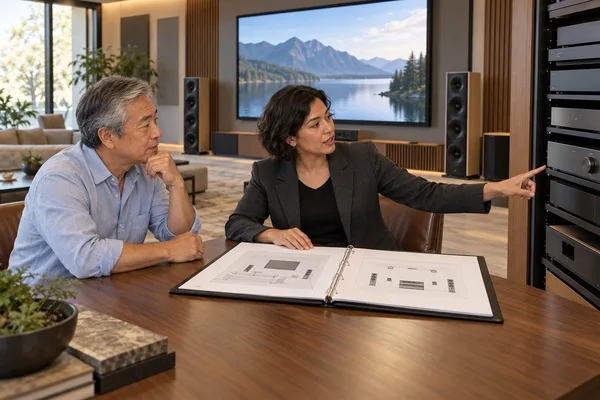
Then ask how the design happens. Does someone visit the property, measure rooms, and ask how you live or work there? Or does the proposal arrive after a ten minute phone call? A good design process starts with questions: who uses each room, what you want to control from your phone, what already exists that should be reused. Be wary of anyone who leads with a specific brand before learning anything about your space. You can read about our team and how we approach design before you meet with us, and you should expect the same transparency from any company you consider.
How do you read an AV scope of work and proposal?
A proper proposal lists every piece of equipment by model, describes the labor and programming, and spells out what is not included. If you cannot tell exactly what you are paying for, the proposal is not finished.
Look for line items, not lump sums. "Whole home audio package" tells you nothing. Six pairs of in-ceiling speakers, a named amplifier, and the rooms they serve tells you a lot. The scope should cover wiring, mounting, programming, testing, and training as separate pieces of work. Check for exclusions like drywall repair, electrical work by others, permit fees, or a network upgrade that the system depends on. Those are the line items that turn into change orders later.
Watch for warning signs too. Prices far below other bids often mean missing labor or equipment that will show up later as extras. Pressure to sign the same day is another red flag. A clear timeline and payment schedule tied to milestones, like rough in, trim out, and final commissioning, protects both sides. Compare proposals line by line, and do not hesitate to ask why one company specified more speakers or a bigger network than another. A good answer will make sense. Our services page shows the kinds of systems we design and install, which can help you compare scopes apples to apples.
Why does service after installation matter so much?
Because every AV and automation system eventually needs updates, adjustments, or a quick fix, and the company that installed it is the one best equipped to help. A system with no support plan becomes a frustration the first time something stops working.
A business owner we met had one thing on his mind: would we be able to help when the system stopped working? His previous system came with an array of controllers but no instructions at all. When things went wrong, he had to call his nephew in to sort out the mess. So we talked through everything with him, from training to installation to ongoing support, before any equipment was ordered.
Ask every company the same questions. Who do you call when a remote stops working? How fast do they respond? Can they troubleshoot remotely? Is there a service agreement, and what does it cover? Central Florida adds its own wear and tear. Summer heat cooks equipment closets without ventilation, and lightning season is hard on electronics, so a company that plans for surge protection and checks in after storms is worth a lot. Training matters too. Everyone who uses the system should know how to operate it without a phone call.
What does a strong AV portfolio actually prove?
A strong portfolio proves an audio visual company has finished projects like yours and done them cleanly. Look past the glamour shots and pay attention to the details.
Clean wire management in the equipment rack, speakers placed with care, TVs mounted level and at the right height, and keypads in sensible spots all show workmanship. Look for projects similar in size and type to yours, whether that is a home theater in Windermere or a conference room in Lake Mary. Ask for references from clients who have lived with their systems for a year or more, since they can tell you how service really works.
You can see finished work in our project gallery and judge it for yourself. When you are ready to talk about your project, call Axiom Integration at (407) 775-2222 or request a consultation, and we will walk you through our design process and a detailed quote.