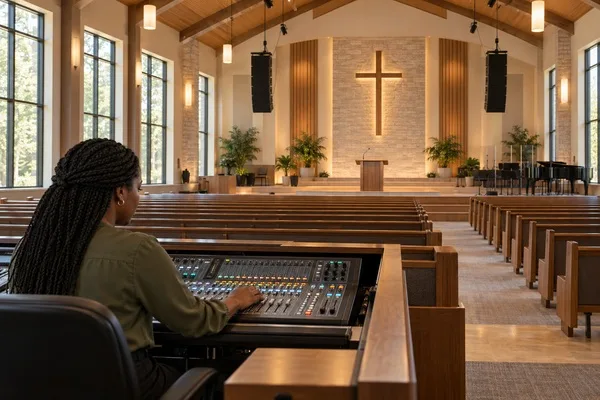
If your congregation keeps saying the sermon sounds muddy, certain seats cannot hear well, or the band drowns out the vocals, your sound system is likely overdue for a professional look. Sound reinforcement systems designed for your specific room fix those problems in a way that new speakers alone usually cannot. To help your committee make an informed decision, contact our team or call (407) 775-2222 to request a system assessment.
What are the telltale signs your church sound system is aging?
Recurring feedback, dead spots where people struggle to hear, and speech that sounds loud but unclear are the three most common warning signs. When volunteers are constantly adjusting the board just to get through a service, the system is no longer doing its job.
Feedback that squeals whenever a pastor walks near the front of the platform usually means speakers and microphones are fighting each other, often because the speaker placement was never designed for how the room is used today. Dead spots show up as complaints from the same sections every week, like the back corners, the balcony, or the overflow seating added during growth. Unintelligible speech is the most frustrating one. The words are loud enough, but the consonants blur together, especially for older members and anyone with hearing loss.
Other signs are quieter. Equipment that is fifteen or twenty years old, mixing boards with channels that no longer work, wireless microphones that drop out, or a system that only one longtime volunteer knows how to run. Congregations across the region, from Kissimmee to Sanford, have grown and changed their worship styles over the last decade, and many systems were installed for a very different kind of service. Our team designs sound reinforcement systems in Orlando and throughout Central Florida with that reality in mind.
Why do room acoustics matter as much as the speakers?
Because the room shapes every sound before it reaches anyone's ears. Even excellent speakers will sound muddy in a space full of hard surfaces that bounce sound back and forth.
Many Central Florida sanctuaries and fellowship halls have tile or polished concrete floors, high ceilings, large windows, and parallel walls. Those surfaces reflect sound, and the reflections arrive at the listener a fraction of a second after the original, smearing speech. Florida adds its own challenges. Air conditioning runs most of the year, adding steady background noise, and a summer storm on a metal roof can bury a quiet moment in a multipurpose building.
That is why turning the volume up rarely helps. We met a church volunteer who told us about a member who had to sit in one particular pew just to be able to hear the sermon. We listened from several locations around the room to understand how we could help, because this was not just a matter of turning the volume up. Louder sound in a reflective room usually means louder echoes too. Real improvements come from pointing sound where people sit, keeping it off the walls and ceiling, and sometimes adding acoustic treatment so the room stops working against the system.
How does a designed sound reinforcement system serve both spoken word and music?
A designed system covers every seat evenly for speech clarity, while still delivering the fullness and impact music needs. It balances the two through speaker selection, placement, and processing tuned to your room.
Spoken word needs clarity above all. Every syllable should reach the back row at a comfortable level without sounding harsh up front. Music needs a wider range, with low end for the bass and drums and enough headroom that the worship team does not have to fight the system. Many churches run a traditional service and a contemporary service on the same weekend, so the system has to handle a single voice at a pulpit and a full band an hour later.
Modern sound reinforcement systems handle this with directional speakers that aim sound at the seating, digital processing that tunes the system to the room, and presets that let a volunteer switch between service styles with one button. Assisted listening options for members with hearing loss can be built in from the start. The goal is a system that sounds consistent from week to week no matter who is running it.
What does a professional sound system assessment include?
A site assessment includes listening to your system in the room, measuring how sound behaves across the seating, reviewing your equipment, and talking with the people who use it. You come away with a clear picture of what is working, what is not, and what it would take to fix it.
During a walk-through, an integrator typically listens from multiple seats, checks coverage in the balcony and overflow areas, and looks at speaker placement, wiring, and the condition of your mixing and wireless gear. Ask that the walk-through happen when your tech volunteers can be there, since they know where problems show up every Sunday. Expect questions about your services, your worship style, and where the congregation is headed, so the design fits your future and not just today.
The result should give your committee something concrete to discuss, whether that is a targeted fix or a phased upgrade spread across budget cycles. To book a walk-through of your sanctuary, call Axiom Integration at (407) 775-2222 or schedule your assessment online.