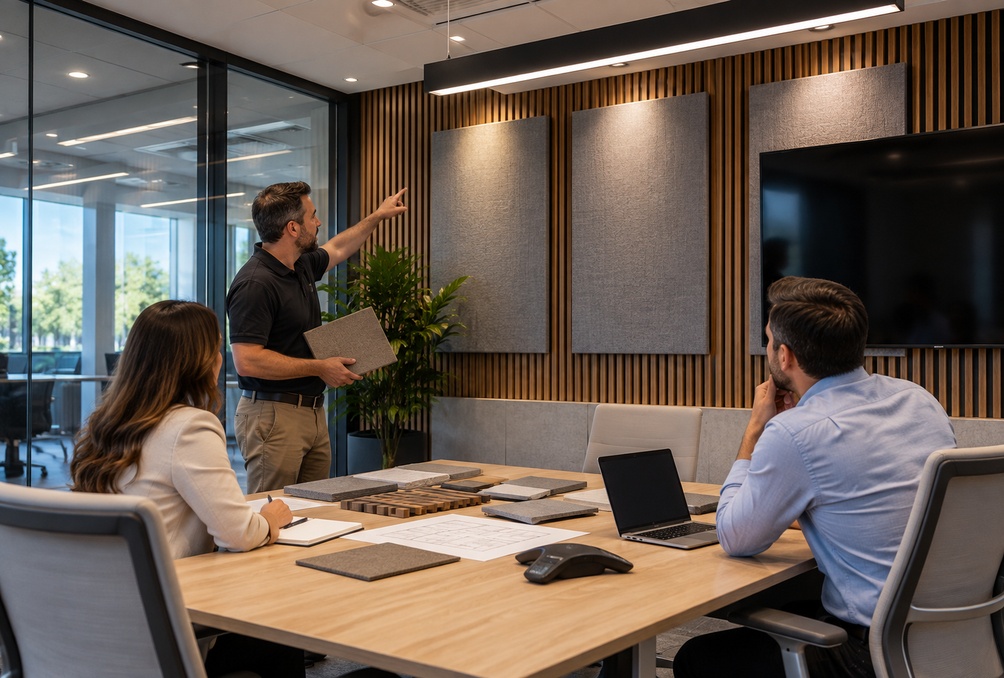
If your conference room sounds echoey, kills video-call clarity, or forces people to repeat themselves through every remote meeting, the problem is almost certainly the room itself, not the microphone. Guessing at treatments rarely fixes it. Axiom Integration offers professional acoustic analysis and design for Central Florida facilities. Call (407) 775-2222 or schedule a consultation before the next round of foam panels gets ordered and the problem stays.
Conference rooms in Central Florida offices share a common set of construction choices that work against good acoustics: hard flooring, glass walls or windows, low ceilings with exposed ductwork, and large flat surfaces with nothing to break up the sound. These rooms look clean and modern. They also produce the flutter echo, long reverberation tails, and background noise buildup that make a forty-five minute call feel like three hours of effort. Knowing when the problem has crossed from minor annoyance into something that requires a real design solution is the first step toward fixing it.
What Symptoms Signal a Real Acoustics Problem Rather Than a Technology Problem?
The clearest signal that a room has an acoustics problem rather than a technology problem is that upgrading the technology did not help. New microphones, a better speakerphone, a ceiling array, higher-end conferencing software: if the call still sounds unclear after the equipment has been replaced, the equipment was not the issue. Sound that bounces off hard surfaces and arrives at the microphone from multiple directions at slightly different times creates the comb filtering and muddiness that most people attribute to bad audio gear. The gear is picking up exactly what the room is producing.
Echoey speech during in-person meetings is another reliable indicator. When people in the room can hear their own voice coming back to them with a slight delay, or when conversations at one end of the table are clearly audible at the other end without any effort, the room's reverberation time is too long for speech intelligibility. A well-treated conference room feels acoustically intimate regardless of its physical size. An untreated one feels like every word is competing with its own reflection.
Background noise buildup during large meetings is a third symptom. As more people speak and move in a reverberant room, the ambient noise floor rises until individual voices are harder to isolate. This is particularly noticeable in hybrid meetings where remote participants are trying to follow a conversation happening in a noisy room. The remote listener hears a wall of indistinct sound rather than clear speech. Treating the room lowers that noise floor and makes individual voices intelligible again without requiring anyone to speak louder or sit closer to the microphone.
How Do Measurement and Analysis Drive the Right Treatment Plan?
Acoustic treatment without measurement is decoration. Foam panels placed on walls because they seem like the right thing to do may absorb some energy in the mid and high frequencies while leaving the low-frequency buildup and flutter echo that were causing the actual problem completely untouched. The result looks treated and sounds roughly the same, sometimes worse if the absorption has changed the room's spectral balance without addressing its reverberation character.
A proper acoustic analysis starts with measurement. Reverberation time, measured as RT60, tells an acoustic designer how long it takes for sound to decay by sixty decibels after the source stops. For a conference room, a target RT60 in the range of 0.4 to 0.6 seconds across speech frequencies produces good intelligibility. A room measuring 1.2 seconds at those frequencies has a specific problem that requires a specific amount and type of absorption, placed at specific locations, to bring it into range. That calculation cannot be done by walking into a room and deciding where foam looks reasonable.
Frequency analysis matters equally. Low-frequency energy accumulates in room corners and along boundaries in ways that broadband panel placement does not address. Bass trapping requires different materials, different thicknesses, and different placement logic than mid and high frequency absorption. A measurement-driven treatment plan identifies exactly where energy is building up and specifies the right treatment for each frequency range rather than applying the same product everywhere and hoping the result averages out to something acceptable.
How Do Acoustic Panels Coordinate With Microphones and Room Design?
Acoustic treatment and microphone selection are not independent decisions. The type of microphone system installed in a room, whether a boundary mic on the table, a ceiling array, or a beamforming unit mounted above the display, determines how the room's treatment should be distributed. A ceiling array microphone picks up sound from a wide overhead zone. If that zone is highly reflective because treatment was concentrated on the walls below, the microphone captures reverb as readily as it captures direct speech. Treatment placed at ceiling height or on the upper portions of walls changes what the microphone actually receives.
A company with a large remote workforce came to us after their conference room had become a genuine obstacle to productive meetings. People were repeating themselves constantly, and the clarity problems persisted even after the organization had replaced the microphone system twice. We measured the room, identified reverberation times that were significantly above the range appropriate for speech, and found specific flutter echo paths between parallel hard surfaces that were compounding the problem. We redesigned the treatment plan to address those specific issues, coordinated the panel placement with the existing ceiling microphone system, and the difference in call clarity was immediate. Meetings that had been draining became functional again.
Room design choices made during construction or renovation also interact with acoustic performance in ways that are worth evaluating before treatment products are specified. Glass walls adjacent to a conference room transmit sound in both directions and reflect internally. Open ceiling plenums allow noise from adjacent spaces to couple into the room acoustically. HVAC diffusers positioned directly above the conference table create background noise that a microphone cannot distinguish from speech. A professional acoustic analysis accounts for all of these factors rather than treating the room as an isolated system.
What Does the Payoff Look Like in Clearer Meetings and Calls?
The practical return on a well-executed acoustic treatment is not subtle. Meetings that previously required participants to raise their voices or repeat themselves become conversational. Remote participants on video calls can follow the room discussion without asking for clarification every few minutes. The cognitive load of straining to understand speech drops, and meetings end faster because less time is spent managing communication failures and more time is spent on the actual agenda.
For facilities where conference rooms are used heavily for client-facing meetings or executive calls, the acoustic quality of those rooms reflects directly on the organization's professional presentation. A room that sounds clear and controlled communicates competence in a way that a visually polished room with poor acoustics does not. The investment in proper acoustic design pays forward every time that room is used, which for a well-utilized conference room in a Central Florida office is likely dozens of times per month.
Treatment that has been specified through measurement and analysis also tends to hold its performance over time better than guesswork solutions, because it addressed the actual problem rather than approximating an improvement. Panels placed in the right locations for the right acoustic reasons do not need to be supplemented or replaced every year as the original problems reassert themselves.
If your Central Florida conference room is hurting meeting productivity and call quality, the right first step is a professional acoustic analysis rather than another product order. Learn more about our Acoustical Analysis and Design service, or call Axiom Integration at (407) 775-2222 and schedule an assessment of your space.